
Cross-Broker Algo Trading in India: A Practical Evaluation Guide
Author and methodology
Layr0
Quantitative research and trading technology team
Layr0 publishes research on market structure, quantitative workflows, broker connectivity, and risk-managed algorithmic execution for Indian and global markets.
Methodology: Research is reviewed for query intent, practical usefulness, and financial risk clarity before publication. Market articles separate observations from predictions and should not be read as investment advice.
This article is educational and operational research. It is not investment advice, and past or backtested performance does not guarantee future results.
Reader question
What should a team compare before adopting a cross-broker algo workflow in India?
Last reviewed: 23 September 2026
Cross-Broker Algo Trading in India: What to Check Before You Connect Accounts
The useful question is not how many broker logos a platform displays. It is whether the platform can preserve the meaning of an order while each broker applies its own authentication, instrument identifiers, order states, limits, and failure rules. One rejected or ambiguous order can undo a strategy that looked excellent in a backtest.
This guide is for Indian traders, developers, and small trading teams comparing broker-connected workflows. It gives you a test plan you can use before placing live orders. It is not a ranking of vendors and it does not assume that any named broker is available for every Layr0 product or account.
Start with the order lifecycle
An API response can mean that a request was accepted for processing. It does not always mean the order is filled. Angel One SmartAPI documentation explicitly notes that an order ID may be returned before the final status is known. Upstox lists several intermediate order states, including pending validation, open, complete, rejected, and cancelled. Zerodha documents postbacks for order-state changes such as complete, rejected, cancelled, and update.
The practical implication is simple: a cross-broker layer needs a common internal record, but it must retain the broker's original response. If the platform displays only “success” immediately after submission, ask how it handles a later rejection, partial fill, or failed cancellation. A dashboard can be visually tidy while its ledger is wrong.
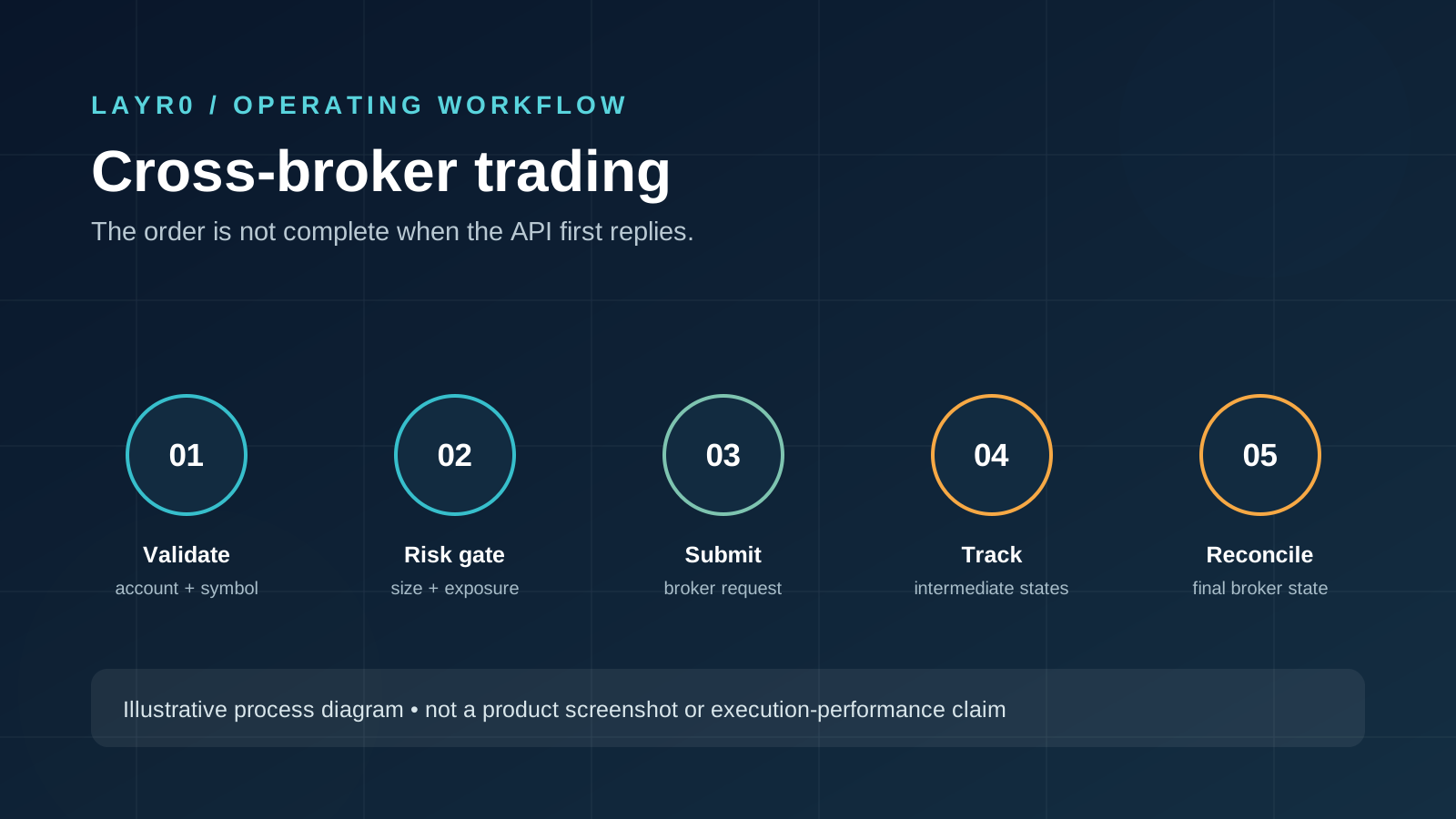
Layr0 / workflow map
A cross-broker order needs five checkpoints
- 01Validate account
- 02Check instrument and margin
- 03Submit once
- 04Track broker status
- 05Reconcile final state
Original Layr0 process infographic. Illustrative workflow; not a product screenshot or a promise of broker availability, execution quality, or investment outcome.
An original Layr0 infographic showing why broker acknowledgement and final order state are separate checkpoints.
Illustrative Layr0 workflow. Source: Layr0 original process diagram · 23 September 2026
Compare failure behavior before feature lists
Ask the same seven questions of every platform and broker combination:
- Authorization: Which broker application, account permissions, and exchange approvals are required? Who owns the API credentials and renewal process?
- Instrument mapping: Does the platform use the broker's current instrument identifier, exchange, product type, and order variety? What happens when a contract expires or a symbol changes?
- Pre-trade checks: Is there an explicit check for usable capital, order size, product eligibility, session status, and your own exposure limits?
- Duplicate prevention: If a network timeout occurs after submission, will a retry create another order? How is that uncertainty reconciled?
- Status tracking: Does the platform distinguish accepted, open, partially filled, complete, rejected, and cancelled states using broker evidence?
- Outage behavior: Does a broker outage pause the strategy, offer a review step, or reroute only when the instrument and account policy allow it?
- Audit trail: Can you reconstruct the signal, operator decision, broker request, response, and final position without relying on screenshots?
These are operational questions. Upstox's place-order documentation shows required fields such as instrument, quantity, product, order type, and trigger price. A “single-click” interface still has to choose valid values for each. Angel One's API reference similarly distinguishes order varieties and explains broker-side validation conditions. Check the live documentation before deployment because broker rules can change.
A useful comparison worksheet
| Criterion | Evidence to request | A weak answer sounds like |
|---|---|---|
| Broker eligibility | Current supported broker and account-mode matrix | “We support all major brokers” |
| Order state | One redacted request-to-final-status trace | “The API returned success” |
| Duplicate protection | Timeout and retry demonstration | “Retries are safe” without an order ledger |
| Risk gates | Configured limits and a rejected example | “The strategy has a stop loss” |
| Recovery | Broker outage and reconnection procedure | “It reconnects automatically” without reconciliation |
| Support boundary | Named owner for broker, platform, and user tasks | “Our team handles everything” |
Try this worksheet in a controlled test account or broker-supported sandbox. Record the date, broker, API version, order type, and the response at each stage. The goal is to find mismatched assumptions while the stakes are small.
Where Layr0 fits
Layr0's product system separates the Trader Central Console, the India Market Connector, and the Android signal-led experience. The Console manages product and license access. IMC connects an eligible Indian broker account and exposes broker-backed trading APIs. The app can use the selected broker and local execution checks for signal-led workflows. The exact combination available to a customer depends on current product access, broker authentication, and account configuration.
Approved product screenshot pending
IMC
Reserved for approved broker selection and a controlled-demo order-status trace. It must not display credentials, account identifiers, or live positions.
For a closer look at the product capability, read Layr0's multi-broker order-routing workflow. For the adjacent questions of strategy evaluation and India-first execution, see how to evaluate AI trading workflows and what a broker-connected trading workflow should include. Vyapar Sanket is the signal-led Android product in the Layr0 ecosystem; review its current app page for availability and supported setup.
Limits and risk
No routing layer guarantees a fill, a price, or a profitable result. Broker outages, exchange controls, market depth, gaps, and account permissions can change the outcome after a strategy emits a signal. Do not infer legal eligibility from a software feature. Confirm the current broker and exchange requirements, start with a small controlled workflow, and keep a human procedure for uncertain order states.
Sources and methodology
Reviewed 23 September 2026. We compared official documentation for the broker order lifecycle and SEBI's retail algo framework. We did not perform a vendor latency benchmark or claim independent fill-quality measurements.
- SEBI: Safer participation of retail investors in algorithmic trading, 4 February 2025.
- Upstox: Place Order API and order status reference, accessed 23 September 2026.
- Angel One: SmartAPI documentation, accessed 23 September 2026.
- Zerodha: Kite Connect postbacks, accessed 23 September 2026.
Related research
Keep exploring this topic
AI Stocks
AI Stock Bubble Debate: A Test for Indian Investors
Use valuation, revenue quality, capital spending, and portfolio exposure to assess AI-market spillover risk without predicting a bubble.
AI Trading
AI Trading Performance in India: How to Test a Model
A decision framework for Indian trading teams evaluating AI-assisted strategies: data leakage, costs, risk, broker status, and live monitoring.
Global Economics
How Global Events Reach Indian Markets
A practical transmission-channel guide to rates, currency, energy, trade, and earnings for India-focused investors.
Next workflow review